









How to Choose a Sports Bra: The 2026 Fit, Support, and Impact Level Guide
To choose a sports bra in 2026, match the impact level to your activity (low for yoga, medium for lifting, high for running), get a snug band that you can fit two fingers under, pick straps that do not dig in, and confirm the cups stay smooth with no spillage or empty space when you move.
If you have ever finished a workout with shoulder dents, side spillage, or a band that crawled up your ribs, the issue was almost never your body. It was the bra. The sports bra you train in controls how much your chest moves, how confident you feel mid-set, and how sore you wake up the next morning. Pick the wrong one and even a 30-minute session feels like a fight. Pick the right one and you stop thinking about it entirely. That is the goal of this guide from Violate The Dress Code: stop the second-guessing, give you a real framework, and help you pick a sports bra that genuinely matches your training in 2026.
Why does the right sports bra actually matter?
A sports bra reduces breast movement by up to 78 percent compared to a standard bra during running, according to research from the University of Portsmouth Research Group in Breast Health. That difference is not cosmetic. The Cooper's ligaments that support breast tissue have no muscle and cannot rebuild stretch once lost, so consistent under-support during training contributes to long-term sagging and chronic upper-back, neck, and shoulder pain. About 17 percent of women report that breast pain has caused them to stop exercising at some point. The right sports bra is, in plain terms, the single most important piece of activewear you own.
Beyond the science, the right bra also unlocks performance. Studies on running gait show that women in properly supportive sports bras take stride lengths roughly 4 millimeters longer than in unsupportive bras, which adds up to about a mile of extra distance over the course of a marathon. For lifters, support translates directly into being able to brace properly on a heavy squat or deadlift instead of clenching to compensate for bounce. Comfort is performance.
How do you choose a sports bra by impact level?
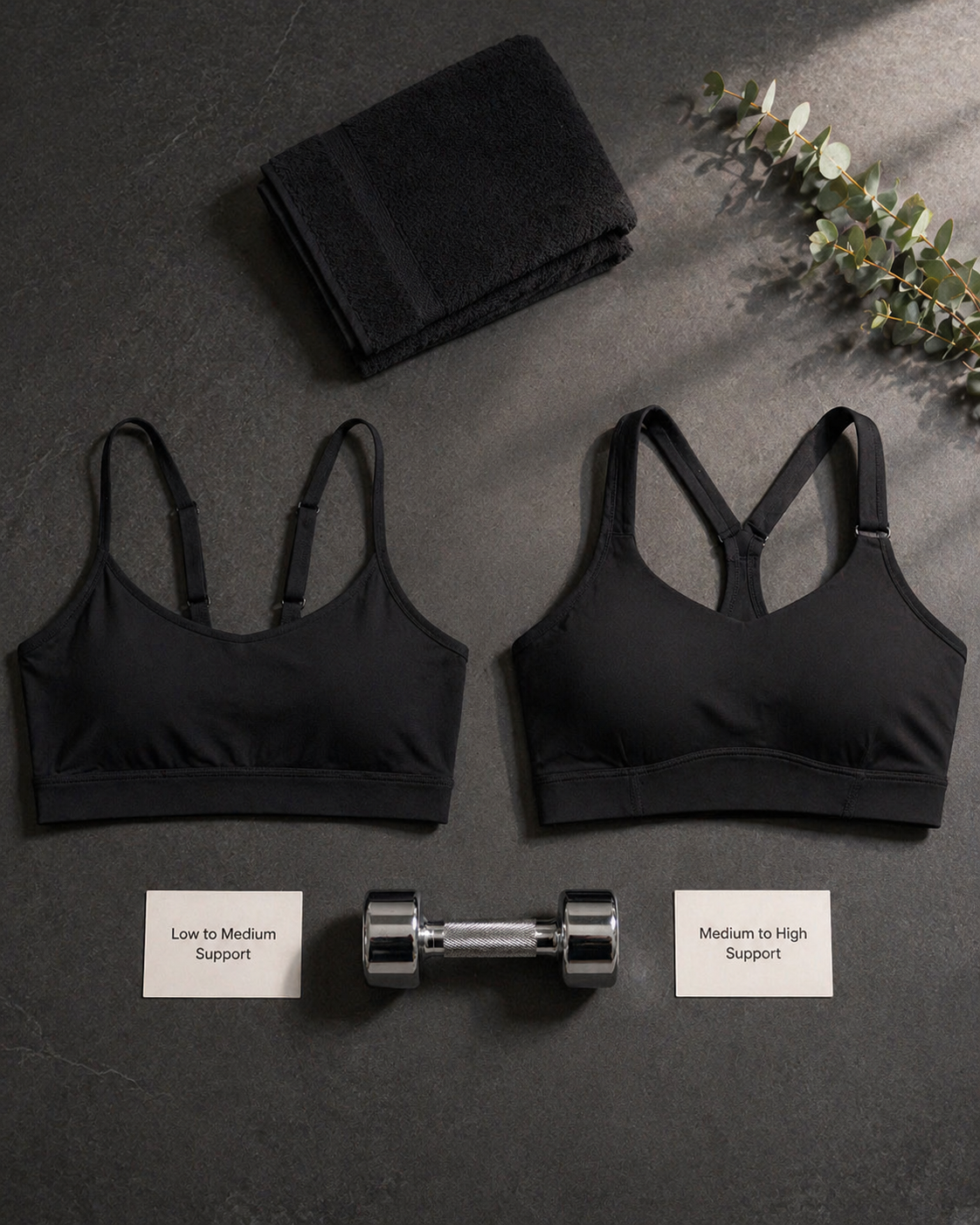
Match the impact level to the activity. Low impact is for yoga, walking, pilates, and stretching. Medium impact is for strength training, cycling, rowing, and dance. High impact is for running, HIIT, jump rope, plyometrics, and most field sports. If your bust is a D cup or larger, size up your impact level by one tier for the same activity.
Low-impact sports bras
Low-impact bras are designed for activities where both feet stay on the ground or movement is controlled and slow. Think pilates reformer work, vinyasa flow, walking, weighted carries at moderate pace, and recovery days. These bras typically use soft compression, removable pads, and stretchy seamless fabric. They are usually pullover style with no underwire and prioritize comfort over lockdown. The Comfy AF Sports Bra is a strong example: a buttery, adjustable, everyday low-to-medium support option that doubles as loungewear and a yoga bra.
Medium-impact sports bras
Medium impact is the sweet spot for most strength training, indoor cycling, dance fitness, kickboxing, and circuit work. You want noticeably more compression and a snugger band than a low-impact bra, plus straps that do not slide off when you reach overhead. Seamless construction with thick, slightly cushioned straps shines here. The Synergy Essential Sports Bra, built with the new Gen 3.0 seamless fabric, is engineered for exactly this range. The thicker, angled straps sit mid-back to keep the bra locked down through every rep without digging.
High-impact sports bras
High-impact bras are non-negotiable for running, HIIT, plyometrics, jump rope, and any sport with sustained jumping. The chest moves in a figure-eight pattern during running, and only a high-impact bra can effectively control all three planes of motion. Look for encapsulation (separate cups for each breast), a wide rib band, reinforced straps, and ideally adjustability. The Triple Threat Sports Bra is built around this principle, with a wider band and reinforced front panel to keep bounce minimal even in sprint intervals.
How should a sports bra fit in 2026?
A correctly fitted sports bra feels snug but never painful. The band sits level around your rib cage and does not ride up when you raise your arms. The straps support without digging. The cups lie flat with no overflow and no empty space. You should be able to slide two fingers, but not three, under the band.
The band
The band does roughly 80 percent of the support work, not the straps. It needs to sit firmly and parallel to the floor at the level of your rib cage, just below the bust. If you raise your arms overhead and the band rides up more than half an inch, the band is too loose, the cup is too small, or both. A band that pinches when you exhale fully is too tight. The fix is almost always to size down the band and up the cup at the same time, which is called a "sister size."
The cups
Cups should encase the entire breast with zero spillage at the top, sides, or center. If you see quad-boob (a second curve at the top of the cup), the cup volume is too small. If the fabric wrinkles or gaps when you move, the cup is too big. Push your hands together in front of you. If the cups buckle, go up a band size. If they pull tight across your sternum, go up a cup size.
The straps
Straps should support, not strangle. You should be able to slide one finger between the strap and your shoulder. Adjustable straps are the gold standard because chest length, torso length, and shoulder slope vary wildly between bodies. If straps cause shoulder grooves after one workout, the band is loose and the straps are picking up slack they were not designed to carry. Tighten the band first, not the straps.
How do I measure for a sports bra at home?
You only need a soft measuring tape and a mirror. Two measurements give you your size in under three minutes.
Step 1: Measure your band size. Wrap the tape snugly around your rib cage directly under your bust. Keep it parallel to the floor. Exhale fully. Round to the nearest whole inch. If the number is even, that is your band size. If it is odd, round up. So 31 inches becomes a 32 band.
Step 2: Measure your bust size. Wrap the tape around the fullest part of your bust, typically right across the nipples. Stand relaxed. Do not pull the tape tight. Round to the nearest whole inch.
Step 3: Subtract band from bust. The difference in inches is your cup size. 1 inch is an A, 2 is a B, 3 is a C, 4 is a D, 5 is a DD, 6 is a DDD/E, 7 is an F, and so on.
Step 4: Cross-check with sister sizing. If your bra brand only carries XS through XL sizing (common with seamless styles), use this rough mapping: 30A-32B = XS, 32C-34B = S, 34C-36B = M, 36C-38B = L, 38C-40B = XL. When in doubt and you are between sizes, size up for low impact and size down for high impact compression.
What are the different sports bra construction types?
Sports bras use three core construction methods. Compression presses the breasts firmly against the chest wall to limit movement. Encapsulation uses individual cups to support each breast separately. Combination bras pair both for maximum support, which is why they dominate the high-impact category.
Compression bras
Compression bras are pullover, often seamless, and rely on stretch fabric to flatten and stabilize. They work best for A through C cups in low and medium-impact training. The upside is comfort, simplicity, and a sleek silhouette under fitted tops. The downside is that for larger busts, compression alone tends to feel restrictive without actually controlling bounce.
Encapsulation bras
Encapsulation bras have molded or stitched cups that surround each breast individually. They look more like a traditional bra in structure and are excellent for D-plus cups because they support each breast in its natural position rather than pressing both flat. Encapsulation alone is best for low-to-medium impact for fuller busts.
Combination bras
Combination bras layer encapsulation under compression, which is the gold standard for high-impact training. The encapsulation isolates each breast and the compression locks both against the body. Almost every dedicated running bra uses this method. The trade-off is that they are slightly less comfortable for all-day wear, but for an actual run or HIIT session they are unmatched.
Sports bra impact level comparison table
| Impact Level | Best For | Construction | Key Features | VTDC Pick |
|---|---|---|---|---|
| Low | Yoga, pilates, walking, recovery | Soft compression, seamless | Removable pads, stretchy band, no underwire | Comfy AF Sports Bra |
| Medium | Lifting, cycling, dance, circuits | Compression with structured straps | Thicker band, angled straps, mid coverage | Synergy Essential Sports Bra |
| Medium-High | Bootcamp, kickboxing, tennis | Compression plus reinforced front | Adjustable straps, higher neckline, removable pads | Uplift Sports Bra |
| High | Running, HIIT, jump rope, plyometrics | Combination (encapsulation plus compression) | Wide band, thicker straps, reinforced panels | Triple Threat Sports Bra |
| Style-Forward | Gym-to-street, photoshoots, brunch | Light compression with design detail | Twist-front detail, low neckline, crossed back | Twist Sports Bra |
How do I choose a sports bra for my body type?
Bra fit is more about ratio than size. Your bust-to-rib ratio, torso length, and shoulder slope all change which silhouette will work best.
If you have a smaller bust (A-B cup): You have the widest range of options. Compression-only bras and seamless pullovers will support you for almost any training. Lean into design details and silhouettes you love. Light-coverage twist styles and longline crop bras can do double duty as a top.
If you have a fuller bust (D-plus): Always look for encapsulation, adjustable straps, a wider band (at least 1.5 inches), and ideally a hook closure for high-impact training. Thin spaghetti straps will not give you the support you need, regardless of how snug the band is. For lifting, a medium-impact seamless with thicker structured straps like the Synergy line works well, but for any running or HIIT, prioritize a true combination high-impact bra.
If you have a long torso: Longline sports bras (think 6 to 8 inch band depth) prevent the band from riding up and can replace a tank entirely.
If you have a short torso: Look for shorter band depths (3 to 4 inches) so the bra does not bunch at the bottom of your ribs or compete with high-rise leggings.
If your shoulders slope: Crossback and racerback styles will hold straps in place far better than standard straight straps.
How often should you replace a sports bra?
Replace a sports bra every 6 to 12 months if you wear it 1 to 2 times per week, and every 3 to 6 months if you wear it daily. The elastic fibers (typically spandex or elastane) lose roughly 30 to 50 percent of their original recovery after about 100 wash cycles, which is when you start to notice the band gaping, the straps stretching, and the cups losing shape. A simple test: stretch the band away from your body. If it does not snap back firmly, retire it.
Signs your sports bra is done include a band that no longer holds when you raise your arms, straps that you have tightened to the maximum and still feel loose, fabric pilling or thinning at high-friction points, padding that has bunched permanently, and noticeably more bounce during the same workout you have done for months.
How should you wash and care for a sports bra?
Sports bras are not built like the rest of your laundry. Hot water, harsh detergent, and dryer heat are what destroy elastic fibers fastest. Five rules will roughly double the life of every bra you own.
1. Wash in cold water. Cold water (under 86 degrees Fahrenheit) preserves spandex elasticity. Hot water shortens it permanently.
2. Use a mesh laundry bag. A 12 to 15 dollar mesh bag protects straps and clasps from snagging on zippers and hooks during the cycle. This single change extends sports bra life by months.
3. Skip fabric softener. Fabric softener coats synthetic fibers and reduces moisture-wicking. It also breaks down elastic faster.
4. Air dry, always. The dryer is the single biggest killer of activewear. Hang or lay flat. Do not wring sports bras out, since that twists and stresses the elastic.
5. Rotate at least three bras. Elastic fibers need 24 hours to fully relax and recover after a workout. Wearing the same bra back-to-back accelerates breakdown.
Best Violate The Dress Code sports bras for every workout in 2026
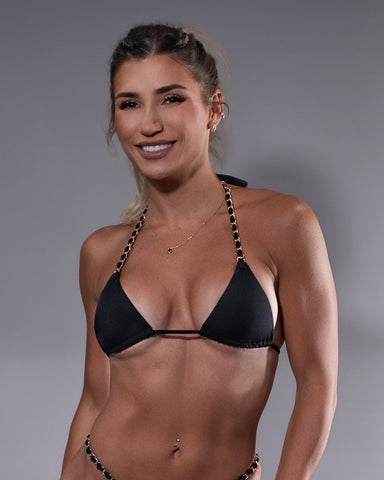
Now that you know the framework, here is how the most popular Violate The Dress Code sports bras map onto real training. Each one was designed by athletes for athletes, with the kind of fit and support women 20 to 35 actually want from premium activewear in 2026. You can browse the full lineup in the VTDC sports bras and tops collection.
Comfy AF Sports Bra (low to medium impact). Adjustable straps, removable pads, and a buttery seamless build that doubles as a loungewear staple. Best for yoga, pilates, light lifting, walking, and travel days. A consistent five-star pick from customers who say they "live in it."
Synergy Essential Sports Bra (medium impact). Built with the Synergy Gen 3.0 seamless fabric and structured angled straps, this is the go-to for lifting, circuits, and dance. Pair it with the matching Synergy Black Seamless Leggings from the Synergy collection for a fully coordinated medium-impact set.
Twist Sports Bra (low to medium impact). The twist-front detail and crossed-back straps make this one of the most photographed bras in the lineup. Pulls double duty for lifting and going out. From the Allure design family.
Uplift Sports Bra (medium to high impact). Higher neckline, reinforced construction, adjustable straps, and removable pads. Strong pick for bootcamp, kickboxing, and tennis where you need lockdown but still want clean lines under fitted tops.
Triple Threat Sports Bra (high impact). Wider band, thicker straps, and reinforced front for running, sprint intervals, and HIIT. The bra to reach for when you need to forget you are wearing one.
With over 90,000 reviews on the Violate The Dress Code reviews page, customers consistently call out fit, comfort, and how well VTDC bras hold up in heavy training rotations. As one verified customer summed it up: "Actually supportive and actually flattering. I did not think I would find both."
Frequently asked questions about choosing a sports bra
How do I know if my sports bra is too small?
If you see breast tissue pushing up over the cups (quad-boob), if the band cuts into your skin and leaves deep marks 30 minutes after taking it off, if you cannot fit two fingers under the band, or if you feel restricted breathing during exercise, your sports bra is too small. Size up the cup first before you size up the band.
Can I wear a sports bra all day?
Low-impact sports bras are designed for all-day wear and are completely safe to wear 8 to 12 hours at a time. Medium and high-impact bras are tighter by design and can cause restricted breathing, skin irritation, and even rib pain if worn too long. Stick to wearing high-impact bras only during the workout itself.
Do I need different sports bras for different workouts?
Yes, ideally. Most active women benefit from owning at least three sports bras: one low-impact for yoga, recovery, and rest days, one medium-impact for lifting and circuits, and one high-impact for running and HIIT. Wearing a low-impact bra for running causes preventable bounce and tissue stress. Wearing a high-impact bra for yoga is unnecessarily restrictive.
What is the best sports bra for big busts?
For D-plus cups, the best sports bras use combination construction (encapsulation plus compression), wide bands of at least 1.5 inches, fully adjustable straps, and ideally a back closure. Avoid thin-strap pullover styles for any high-impact training. A reinforced front panel like the one on the Triple Threat Sports Bra is what you want for running.
How do I stop a sports bra from riding up?
A sports bra rides up because the band is too loose. Tighten the band by going down a band size and up a cup size (sister sizing) so the volume stays the same. If you already wear the smallest band that fits, look for a longline style or a sports bra with silicone band grippers, which are common in higher-impact construction.
Are seamless sports bras supportive enough for working out?
Seamless sports bras are excellent for low and medium-impact training and many handle bootcamp-level intensity. The Synergy Gen 3.0 seamless fabric, for example, holds up across most strength training and cardio circuits. For sustained running and HIIT, a dedicated combination high-impact bra still outperforms even the best seamless.
How tight should a sports bra band be?
Tight enough that you can slide two flat fingers under it, but not three. The band should sit parallel to the floor and not move when you raise your arms overhead. If the band rolls, flips, or rides up, it is too loose, regardless of how tight the cups feel.
What is the difference between compression and encapsulation sports bras?
Compression sports bras press both breasts against the chest wall to limit movement and are typically pullover styles. Encapsulation sports bras have separate cups for each breast and look more like traditional bras in structure. Compression works best for smaller busts in low-to-medium impact training. Encapsulation works best for fuller busts and pairs with compression in high-impact bras.
Written by Andie Grey. Founder and athlete at Violate The Dress Code. Designing performance apparel built from real training experience for women who refuse to choose between function and style.

Leave a comment
All comments are moderated before being published.
This site is protected by hCaptcha and the hCaptcha Privacy Policy and Terms of Service apply.